
Trosort Team


"Imagine a sorter with 20 years of experience whose knowledge is shared across your entire system, 24/7. That is the power of combining Computer Vision with Machine Learning: an eye that never tires and a brain that never forgets your specific rules."
You likely already know that it is possible to automate sorting for recycling. Industry leaders like Valvan, Tomra, and New Retex have all created impressive machinery designed to do just that.
But did you know it is now also possible to automate sorting for Reuse?
Now, you probably think I’m a "Zieveraar" (a Belgian term for someone talking rubbish). You might think a machine will never be capable of doing a human sorter’s job—that deciding a garment's category is far too complex and subjective to be automated.
I agree with you: it is complex. But is it really subjective?
(Spoiler: No)
Sorting isn’t Subjective
A human sorter's "feeling" is actually just their brain recognizing a pattern.
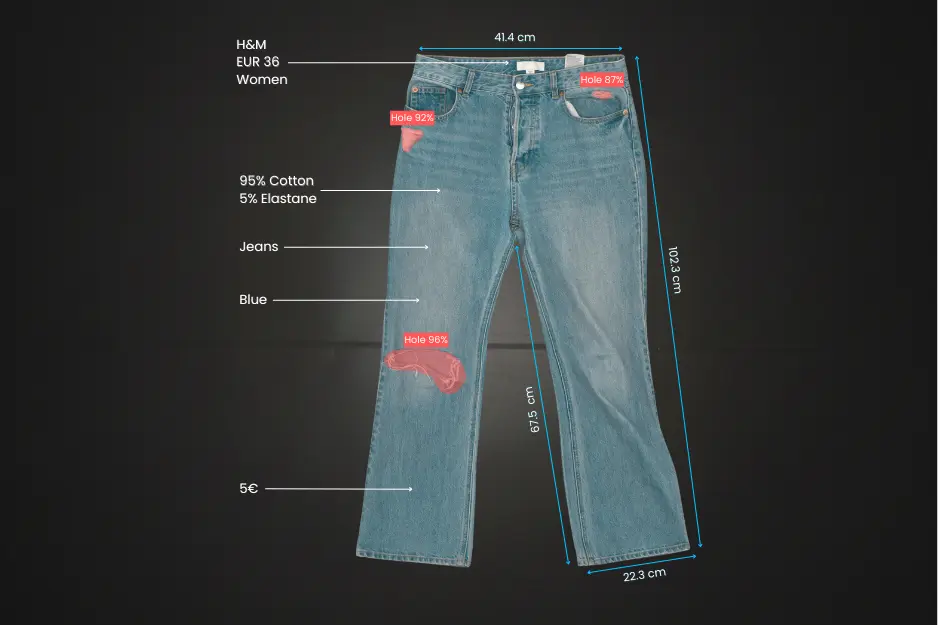
Grade A: A pair of Levi’s jeans with exactly one 4 cm² hole located on the knee.
Grade B, C, or D: A pair of Zeeman jeans with three holes larger than 2 cm² and fraying on the bottoms (depending on your specific rules).
This pattern recognition is exactly why computer algorithms can help. Which leads us to the big question: How can sorting for Reuse be automated?
To understand the answer, we need to look at two core concepts:
1. Computer Vision (The Eye)
Think of this as a digital eye that never gets tired. It converts pixels into data by breaking down images into shapes, colors, and textures. This allows the system to identify exactly what is in front of the camera, whether it’s a T-shirt or a coat, a specific brand logo, a tiny 3mm hole, or the exact length of a sleeve.
2. Machine Learning (The Brain)
This "brain" processes the data from the Eye. It recognizes patterns from millions of previously analyzed garments to make split-second decisions. It learns your center’s specific logic. It is essentially like having a sorter with 20 years of experience whose knowledge is shared across your entire system, 24/7.
How it Works: From Image to Decision
The process is straightforward: Based on images of your garments, Computer Vision models combined with Machine Learning algorithms detect everything visible to the eye and redirect items based on the rules you set.
A machine can now sort garments based on several key characteristics:
Characteristic | Method of Detection |
Type | Identification of shorts, T-shirts, coats, etc. |
Brand | Recognition via labels or logos. |
Fabric | NIR scanners or high-spectral cameras. |
Size | Extracted from labels or physical dimensions. |
Color | Precise RGB detection. |
The Limits of Computer Vision
Of course, technology has its boundaries. Put simply: a machine can't see what isn't visible without manipulating the garment.
This includes:
The inside of pockets.
Whether clothes are wet.
Whether the garment has a smell.
While most of these problems are solvable, there remains one "blind spot" that is much harder to resolve—but we will save that for next time.
Stay tuned for more insights into how AI is transforming the world of textile sorting.
You likely already know that it is possible to automate sorting for recycling. Industry leaders like Valvan, Tomra, and New Retex have all created impressive machinery designed to do just that.
But did you know it is now also possible to automate sorting for Reuse?
Now, you probably think I’m a "Zieveraar" (a Belgian term for someone talking rubbish). You might think a machine will never be capable of doing a human sorter’s job—that deciding a garment's category is far too complex and subjective to be automated.
I agree with you: it is complex. But is it really subjective?
(Spoiler: No)
Sorting isn’t Subjective
A human sorter's "feeling" is actually just their brain recognizing a pattern.
Grade A: A pair of Levi’s jeans with exactly one 4 cm² hole located on the knee.
Grade B, C, or D: A pair of Zeeman jeans with three holes larger than 2 cm² and fraying on the bottoms (depending on your specific rules).
This pattern recognition is exactly why computer algorithms can help. Which leads us to the big question: How can sorting for Reuse be automated?
To understand the answer, we need to look at two core concepts:
1. Computer Vision (The Eye)
Think of this as a digital eye that never gets tired. It converts pixels into data by breaking down images into shapes, colors, and textures. This allows the system to identify exactly what is in front of the camera, whether it’s a T-shirt or a coat, a specific brand logo, a tiny 3mm hole, or the exact length of a sleeve.
2. Machine Learning (The Brain)
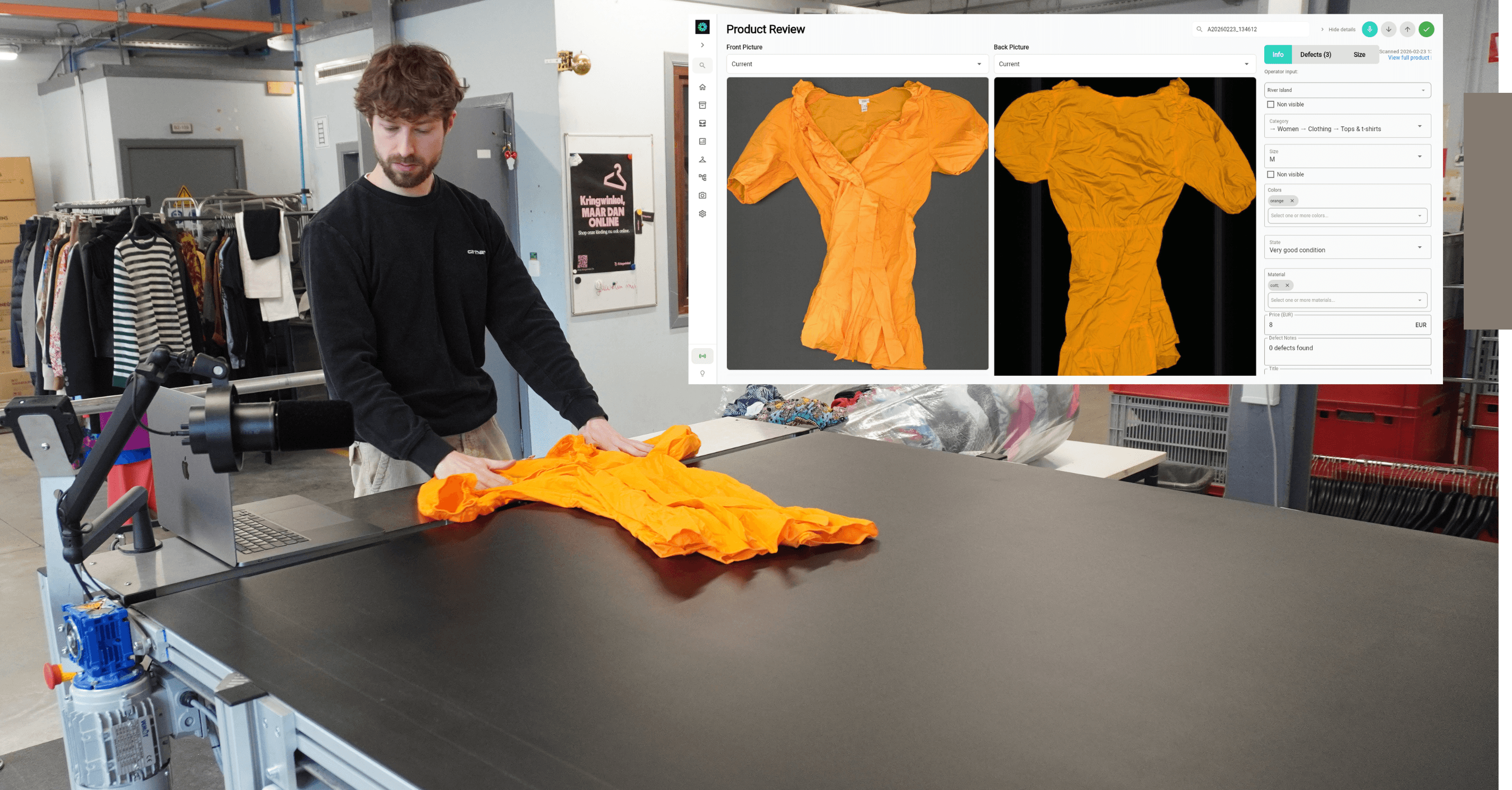
This "brain" processes the data from the Eye. It recognizes patterns from millions of previously analyzed garments to make split-second decisions. It learns your center’s specific logic. It is essentially like having a sorter with 20 years of experience whose knowledge is shared across your entire system, 24/7.
How it Works: From Image to Decision
The process is straightforward: Based on images of your garments, Computer Vision models combined with Machine Learning algorithms detect everything visible to the eye and redirect items based on the rules you set.
A machine can now sort garments based on several key characteristics:
Characteristic | Method of Detection |
Type | Identification of shorts, T-shirts, coats, etc. |
Brand | Recognition via labels or logos. |
Fabric | NIR scanners or high-spectral cameras. |
Size | Extracted from labels or physical dimensions. |
Color | Precise RGB detection. |
The Limits of Computer Vision
Of course, technology has its boundaries. Put simply: a machine can't see what isn't visible without manipulating the garment.
This includes:
The inside of pockets.
Whether clothes are wet.
Whether the garment has a smell.
While most of these problems are solvable, there remains one "blind spot" that is much harder to resolve—but we will save that for next time.
Stay tuned for more insights into how AI is transforming the world of textile sorting.
You likely already know that it is possible to automate sorting for recycling. Industry leaders like Valvan, Tomra, and New Retex have all created impressive machinery designed to do just that.
But did you know it is now also possible to automate sorting for Reuse?
Now, you probably think I’m a "Zieveraar" (a Belgian term for someone talking rubbish). You might think a machine will never be capable of doing a human sorter’s job—that deciding a garment's category is far too complex and subjective to be automated.
I agree with you: it is complex. But is it really subjective?
(Spoiler: No)
Sorting isn’t Subjective
A human sorter's "feeling" is actually just their brain recognizing a pattern.
Grade A: A pair of Levi’s jeans with exactly one 4 cm² hole located on the knee.
Grade B, C, or D: A pair of Zeeman jeans with three holes larger than 2 cm² and fraying on the bottoms (depending on your specific rules).
This pattern recognition is exactly why computer algorithms can help. Which leads us to the big question: How can sorting for Reuse be automated?
To understand the answer, we need to look at two core concepts:
1. Computer Vision (The Eye)
Think of this as a digital eye that never gets tired. It converts pixels into data by breaking down images into shapes, colors, and textures. This allows the system to identify exactly what is in front of the camera, whether it’s a T-shirt or a coat, a specific brand logo, a tiny 3mm hole, or the exact length of a sleeve.
2. Machine Learning (The Brain)
This "brain" processes the data from the Eye. It recognizes patterns from millions of previously analyzed garments to make split-second decisions. It learns your center’s specific logic. It is essentially like having a sorter with 20 years of experience whose knowledge is shared across your entire system, 24/7.
How it Works: From Image to Decision
The process is straightforward: Based on images of your garments, Computer Vision models combined with Machine Learning algorithms detect everything visible to the eye and redirect items based on the rules you set.
A machine can now sort garments based on several key characteristics:
Characteristic | Method of Detection |
Type | Identification of shorts, T-shirts, coats, etc. |
Brand | Recognition via labels or logos. |
Fabric | NIR scanners or high-spectral cameras. |
Size | Extracted from labels or physical dimensions. |
Color | Precise RGB detection. |
The Limits of Computer Vision
Of course, technology has its boundaries. Put simply: a machine can't see what isn't visible without manipulating the garment.
This includes:
The inside of pockets.
Whether clothes are wet.
Whether the garment has a smell.
While most of these problems are solvable, there remains one "blind spot" that is much harder to resolve—but we will save that for next time.
Stay tuned for more insights into how AI is transforming the world of textile sorting.
You likely already know that it is possible to automate sorting for recycling. Industry leaders like Valvan, Tomra, and New Retex have all created impressive machinery designed to do just that.
But did you know it is now also possible to automate sorting for Reuse?
Now, you probably think I’m a "Zieveraar" (a Belgian term for someone talking rubbish). You might think a machine will never be capable of doing a human sorter’s job—that deciding a garment's category is far too complex and subjective to be automated.
I agree with you: it is complex. But is it really subjective?
(Spoiler: No)
Sorting isn’t Subjective
A human sorter's "feeling" is actually just their brain recognizing a pattern.
Grade A: A pair of Levi’s jeans with exactly one 4 cm² hole located on the knee.
Grade B, C, or D: A pair of Zeeman jeans with three holes larger than 2 cm² and fraying on the bottoms (depending on your specific rules).
This pattern recognition is exactly why computer algorithms can help. Which leads us to the big question: How can sorting for Reuse be automated?
To understand the answer, we need to look at two core concepts:
1. Computer Vision (The Eye)
Think of this as a digital eye that never gets tired. It converts pixels into data by breaking down images into shapes, colors, and textures. This allows the system to identify exactly what is in front of the camera, whether it’s a T-shirt or a coat, a specific brand logo, a tiny 3mm hole, or the exact length of a sleeve.
2. Machine Learning (The Brain)
This "brain" processes the data from the Eye. It recognizes patterns from millions of previously analyzed garments to make split-second decisions. It learns your center’s specific logic. It is essentially like having a sorter with 20 years of experience whose knowledge is shared across your entire system, 24/7.
How it Works: From Image to Decision
The process is straightforward: Based on images of your garments, Computer Vision models combined with Machine Learning algorithms detect everything visible to the eye and redirect items based on the rules you set.
A machine can now sort garments based on several key characteristics:
Characteristic | Method of Detection |
Type | Identification of shorts, T-shirts, coats, etc. |
Brand | Recognition via labels or logos. |
Fabric | NIR scanners or high-spectral cameras. |
Size | Extracted from labels or physical dimensions. |
Color | Precise RGB detection. |
The Limits of Computer Vision
Of course, technology has its boundaries. Put simply: a machine can't see what isn't visible without manipulating the garment.
This includes:
The inside of pockets.
Whether clothes are wet.
Whether the garment has a smell.
While most of these problems are solvable, there remains one "blind spot" that is much harder to resolve—but we will save that for next time.
Stay tuned for more insights into how AI is transforming the world of textile sorting.