Returns, Excess Stock and Surplus, Graded and Routed in One Touch
Returns, Excess Stock and Surplus, Graded and Routed in One Touch
Returns, Excess Stock and Surplus, Graded and Routed in One Touch
For 3PLs and brand logisticians. SortMate scans every garment, from e-commerce returns to overstock and surplus, decides where it goes (back to stock, outlet, resale, repair or recycling) and keeps a record for each brand.
Up to 1,000 returns per hour · 11 data points per garment · Present in 7 countries
Two Ways In
Two Ways In
Two Ways In

E-commerce Returns
E-commerce Returns
E-commerce Returns
1. Scan the return box. One barcode links every item to its order, customer and brand.
1. Scan the return box. One barcode links every item to its order, customer and brand.
1. Scan the return box. One barcode links every item to its order, customer and brand.
2. Lay garments flat. Two operators place items on the belt, in any order.
2. Lay garments flat. Two operators place items on the belt, in any order.
2. Lay garments flat. Two operators place items on the belt, in any order.
3. Check the right item came back. Each garment is compared with the catalogue: right product, size and colour. Swaps and missing items are flagged.
3. Check the right item came back. Each garment is compared with the catalogue: right product, size and colour. Swaps and missing items are flagged.
3. Check the right item came back. Each garment is compared with the catalogue: right product, size and colour. Swaps and missing items are flagged.

Deadstock & Surplus
Deadstock & Surplus
Deadstock & Surplus
1. Scan the lot label, if there is one. A lot, pallet or SKU barcode links items, including defective stock, to their brand and batch. No label? SortMate identifies brand and category from the image.
1. Scan the lot label, if there is one. A lot, pallet or SKU barcode links items, including defective stock, to their brand and batch. No label? SortMate identifies brand and category from the image.
1. Scan the lot label, if there is one. A lot, pallet or SKU barcode links items, including defective stock, to their brand and batch. No label? SortMate identifies brand and category from the image.
2. Lay garments flat. Two operators place items on the belt, in any order.
2. Lay garments flat. Two operators place items on the belt, in any order.
2. Lay garments flat. Two operators place items on the belt, in any order.
3. Check condition and composition. Defects are detected down to 3 mm, and fibre composition is read by an NIR or hyperspectral sensor.
3. Check condition and composition. Defects are detected down to 3 mm, and fibre composition is read by an NIR or hyperspectral sensor.
3. Check condition and composition. Defects are detected down to 3 mm, and fibre composition is read by an NIR or hyperspectral sensor.
One Line From Here
One Line From Here
One Line From Here

One Scan, 11 Data Points
One Scan, 11 Data Points
One Scan, 11 Data Points
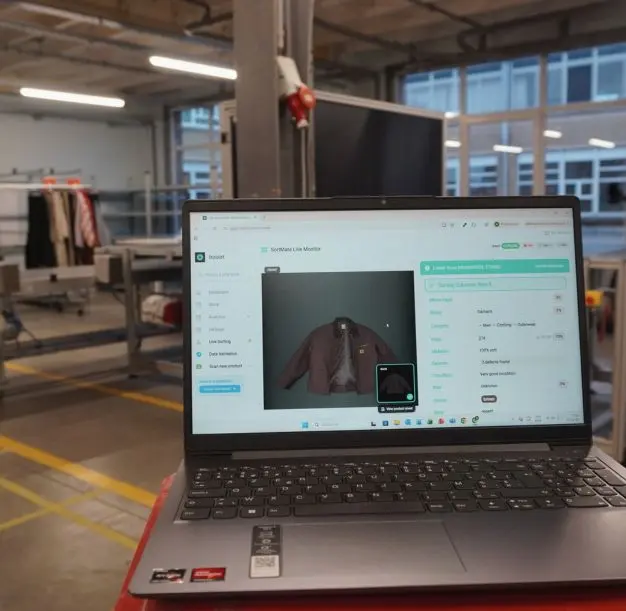
From here, both flows run on the same line. Front and back imaging plus fibre reading capture category, brand, size, colour, style, condition, defects, composition, seasonality and resale value for every garment.
From here, both flows run on the same line. Front and back imaging plus fibre reading capture category, brand, size, colour, style, condition, defects, composition, seasonality and resale value for every garment.
From here, both flows run on the same line. Front and back imaging plus fibre reading capture category, brand, size, colour, style, condition, defects, composition, seasonality and resale value for every garment.
Your Rules, per Brand
Your Rules, per Brand
Your Rules, per Brand
Each brand gets its own grading standard, destinations and reports. Switch sorting scenarios per client in seconds, without stopping the line, and add new destinations whenever a client needs them.
Each brand gets its own grading standard, destinations and reports. Switch sorting scenarios per client in seconds, without stopping the line, and add new destinations whenever a client needs them.
Each brand gets its own grading standard, destinations and reports. Switch sorting scenarios per client in seconds, without stopping the line, and add new destinations whenever a client needs them.


A Destination for Every Garment
A Destination for Every Garment
A Destination for Every Garment
Unsold and returned goods need a documented second life. SortMate routes each piece to restock, outlet, resale, donation, repair, upcycling or recycling, following the rules you set for each brand.
Unsold and returned goods need a documented second life. SortMate routes each piece to restock, outlet, resale, donation, repair, upcycling or recycling, following the rules you set for each brand.
Unsold and returned goods need a documented second life. SortMate routes each piece to restock, outlet, resale, donation, repair, upcycling or recycling, following the rules you set for each brand.
Labelled, Traced and Connected
Labelled, Traced and Connected
Labelled, Traced and Connected
An automatic printer labels each piece right after the scan, and every result flows into your WMS. We supply the scanning line: it feeds your existing conveyor or our own sorting line. Your brand clients get item-level reports: what came in, its grade and where it went.
An automatic printer labels each piece right after the scan, and every result flows into your WMS. We supply the scanning line: it feeds your existing conveyor or our own sorting line. Your brand clients get item-level reports: what came in, its grade and where it went.
An automatic printer labels each piece right after the scan, and every result flows into your WMS. We supply the scanning line: it feeds your existing conveyor or our own sorting line. Your brand clients get item-level reports: what came in, its grade and where it went.

Where It Goes
Where It Goes
Where It Goes

Returns: Back to Stock
Returns: Back to Stock
Returns: Back to Stock
Perfect items are repacked on the spot and go straight back to stock.
Perfect items are repacked on the spot and go straight back to stock.
Perfect items are repacked on the spot and go straight back to stock.
Items with light defects go to washing or repair first, then back to stock or to the outlet.
Items with light defects go to washing or repair first, then back to stock or to the outlet.
Items with light defects go to washing or repair first, then back to stock or to the outlet.

Surplus: Sell or Recycle
Surplus: Sell or Recycle
Surplus: Sell or Recycle
Sellable pieces get professional packshots and a complete listing in about 15 seconds, ready for outlets and webshops.
Sellable pieces get professional packshots and a complete listing in about 15 seconds, ready for outlets and webshops.
Sellable pieces get professional packshots and a complete listing in about 15 seconds, ready for outlets and webshops.
The rest goes to donation, upcycling or fibre recycling, sorted by composition.
The rest goes to donation, upcycling or fibre recycling, sorted by composition.
The rest goes to donation, upcycling or fibre recycling, sorted by composition.
How to get Started?
Accessing a great solution shouldn't be time-consuming…
How to get Started?
Accessing a great solution shouldn't be time-consuming…
How to get Started?
Accessing a great solution shouldn't be time-consuming…
Learn More
Learn More
Learn More
Discover how SortMate sorts every garment, the hardware behind it and the software your team would use.
Discover how SortMate sorts every garment, the hardware behind it and the software your team would use.
Discover how SortMate sorts every garment, the hardware behind it and the software your team would use.



FAQ
Quick answers to commonly asked questions.
Couldn’t find what you were looking for?
write to us at
What can SortMate detect on a garment?
SortMate identifies a garment's category, brand, colour, fibre composition, defects and overall condition in a single scan. It combines computer vision with near-infrared (NIR) or hyperspectral sensors, and can also suggest a resale price and a vintage score for each item.
How many garments can SortMate sort per hour?
With two operators feeding the machine, SortMate processes about 1,200 garments per hour when sorting for resale, which is around 8,400 garments or 3 tonnes per shift. When sorting for recycling it reaches up to 3,600 garments per hour, and for fashion returns about 1,000 items per hour.
How accurate is SortMate?
Accuracy depends on what you want to detect. Clear attributes such as brand and garment category are detected very reliably, while subtle defects such as loose stitches or pilling are harder. During onboarding we measure accuracy on your own garments and tune the system until your team no longer needs to recheck its output.
Can SortMate learn our own grades and categories?
Yes. SortMate is set up on your own grades and categories, and you can define more than 450 categories with your own sorting rules. To discover how it works for your operation, book a call with our team.
Can SortMate sort for reuse and recycling at the same time?
Yes. In one single pass, SortMate sorts for recycling thanks to its near-infrared (NIR) or hyperspectral sensor, which identifies fibre composition, and for reuse thanks to all the other data points it captures, such as brand, condition and estimated resale price. Each item is then routed to the right output according to your rules.
Can SortMate identify fibre composition?
Yes. SortMate's near-infrared (NIR) or hyperspectral sensor measures the material composition of each garment, distinguishing for example cotton, polyester and blends. This is key for feeding the right recycling streams.
Can SortMate process shoes, bags or accessories?
SortMate processes garments and flat accessories such as scarves, caps and belts. Shoes and bags are not supported at the moment.
What if SortMate doesn't work for our operation?
Every project starts with an onboarding period in which we tune SortMate to your garments and grades together, so you can evaluate the results on your own operation before committing long-term.
Who maintains the machine?
Trosort does. Maintenance and software updates are part of our service. Outside Europe, on-site support is provided through a local technical partner.
Can SortMate connect to our systems?
Yes. SortMate integrates with your warehouse management, ERP or point-of-sale systems, so item data, labels and sales information flow automatically. It can also print a label for each garment right after the scan.
How long does it take from order to operation?
Delivery takes 6 to 9 weeks in Europe and 12 to 16 weeks in the United States. Installation and operator training on site take 2 to 5 days.
Where can I see SortMate in action?
You can see SortMate running live in our showroom. Book a meeting to plan a visit, or join a live video demo.
Who already uses SortMate?
SortMate is present in 7 countries, at sorting centers, retailers and logistics companies, sorting for resale, recycling and fashion returns.
Who owns the data SortMate generates?
You do. All data generated by scanning your garments remains your property; Trosort only uses it to improve its detection accuracy. Your sorting rules and processes are your own IP and remain completely confidential.
Next-Gen Textile Sorting Automation for
Reuse and Recycling
Supported by

and the European Union

Next-Gen Textile Sorting Automation for
Reuse and Recycling
Supported by
and the European Union