Textile Sorting Software
Textile Sorting Software
Textile Sorting Software

SortMate's AI software bridges the gap between hardware and operations. By digitizing your entire workflow in real-time, the system automates complex sorting decisions and category management. This enables you to track facility performance and maximize the value of every sorted batch in your textile sorting center.
SortMate’s AI software bridges the gap between hardware and operations. By digitizing your entire workflow in real-time, the system automates complex sorting decisions and category management. This enables you to track facility performance and maximize the value of every sorted batch in your textile sorting center.
SortMate’s AI software bridges the gap between hardware and operations. By digitizing your entire workflow in real-time, the system automates complex sorting decisions and category management. This enables you to track facility performance and maximize the value of every sorted batch in your textile sorting center.
The Process
The Process
The Process
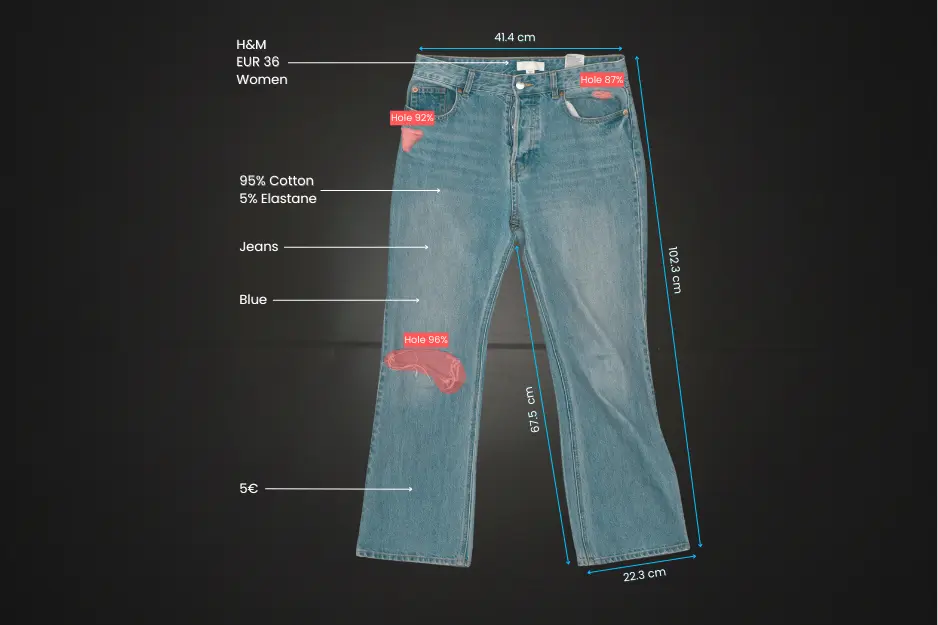
Identification
Identification
Using 360° imaging, our software recognizes brands, categories, defects, size, color, gender and more. It applies multi-model image analysis algorithms, trained on a vast proprietary library of garment images, allowing the system to distinguish between a fabric fold and a 3mm hole. This precise identification layer ensures every item is digitized with total accuracy, providing a full data profile for every garment that enters your facility.
Using 360° imaging, our software recognizes brands, categories, defects, size, color, gender and more. It applies multi-model image analysis algorithms, trained on a vast proprietary library of garment images, allowing the system to distinguish between a fabric fold and a 3mm hole. This precise identification layer ensures every item is digitized with total accuracy, providing a full data profile for every garment that enters your facility.
Grading & Pricing
Grading & Pricing
Our software assesses each garment's condition based on the type, severity, location and number of defects, assigning grades (A, B, C) according to your specific internal rules. A dynamic pricing engine then analyzes millions of market transactions to assign a real-time value based on brand, condition, and material composition. Our pricing engine ensures consistent pricing and maximizes the revenue potential for every individual item.
Our software assesses each garment’s condition based on the type, severity, location and number of defects, assigning grades (A, B, C) according to your specific internal rules. A dynamic pricing engine then analyzes millions of market transactions to assign a real-time value based on brand, condition, and material composition. Our pricing engine ensures consistent pricing and maximizes the revenue potential for every individual item.
Our software assesses each garment’s condition based on the type, severity, location and number of defects, assigning grades (A, B, C) according to your specific internal rules. A dynamic pricing engine then analyzes millions of market transactions to assign a real-time value based on brand, condition, and material composition. Our pricing engine ensures consistent pricing and maximizes the revenue potential for every individual item.

Sorting
Sorting
Our software enables sorting into more than 450 categories that can be created or modified instantly to meet seasonal demand or urgent operational shifts. You can define categories using any combination of detected elements, such as "Grade A, Blue Jeans valued above 5 €", and deploy them autonomously. It allows you to adapt your sorting logic in seconds, ensuring your output always aligns with current market requirements and facility goals.
Our software enables sorting into more than 450 categories that can be created or modified instantly to meet seasonal demand or urgent operational shifts. You can define categories using any combination of detected elements, such as "Grade A, Blue Jeans valued above 5 €", and deploy them autonomously. It allows you to adapt your sorting logic in seconds, ensuring your output always aligns with current market requirements and facility goals.
Technical Specifications
Technical Specifications
Defects
Defects
Defects
Our AI recognizes defects - including stains, holes, pilling, fraying, and fading - down to a 3 mm scale.
Each detected defect is enriched with specific data points: size, severity, location, and confidence level.
These factors are then cross-referenced to assign a final condition to the garment based on your specific grading parameters.


Sorting Rules
Sorting Rules
Build custom sorting categories based on any garment characteristic our AI detects. You can sort by brand, size, material composition, or a combination of all attributes simultaneously.
Our system allows you to create new categories or adapt existing ones instantly, giving you full control over your sorting floor. Review the comprehensive list of detectable characteristics below.
Accuracies
Accuracies
Detailed accuracy reports and detection benchmarks are available upon request. To protect our proprietary machine learning models and ensure data is interpreted within the correct operational context, we share these specifications during one-on-one meetings.
Detailed accuracy reports and detection benchmarks are available upon request. To protect our proprietary machine learning models and ensure data is interpreted within the correct operational context, we share these specifications during one-on-one meetings.
Detailed accuracy reports and detection benchmarks are available upon request. To protect our proprietary machine learning models and ensure data is interpreted within the correct operational context, we share these specifications during one-on-one meetings.


Integrations
Integrations
Our system continuously learns from the real-time sales data generated in your retail stores.
By integrating directly with your ERP and POS systems, SortMate establishes a closed-loop feedback system between your selling and sorting operations.
This data-driven approach optimizes your margins by routing every item to the specific retail location where it is projected to achieve the highest sale price.
Stock Management & Analytics
Stock Management & Analytics
With SortMate, every garment and its movement is fully digitized. You can access individual product sheets for every scanned item to review its assigned grade, market value, and category in real-time.
Our system tracks both facility-wide and resale metrics, allowing you to monitor processed tonnage and incoming quality alongside total products sold and revenue per selling point.
This granular visibility provides the data necessary to optimize every stage of your operation, ensuring your sorting logic is perfectly aligned with your resale performance.

Data Fields
What SortMate Sees
What SortMate Sees
These are all the characteristics our AI detects and is able to sort on, with possible associated values or real examples.
These are all the characteristics our AI detects and is able to sort on, with possible associated values or real examples.
These are all the characteristics our AI detects and is able to sort on, with possible associated values or real examples.
Category
400 + pre-trained categories Ex: Women > Clothing > T-Shirts
Brand
Zara, H&M, Nike, … + 55 000 other brands
Defects
Pilling, stains, holes, fraying, fading, missing pieces
Material Composition
80% cotton, 20% polyester
Price
Resale price suggestion (EUR)
Recycling Disruptors
Zippers & buttons
Size
Detected size among : baby, kids, men/women (58 different sizes)
Size in cm
Precise garment size in centimeters (height, width, sleeves)
Condition
New with tags , New without tags, Very good, Good, Satisfactory
Style
Vintage, Bohemian, Minimalist, Grunge , Sporty, Eclectic, Retro
Type
accessories or clothing
Gender
Women, Men, Boys, Girls
How to get Started?
Accessing a great solution shouldn't be time-consuming…
How to get Started?
Accessing a great solution shouldn't be time-consuming…
How to get Started?
Accessing a great solution shouldn't be time-consuming…
Learn More
Learn More
Learn More
Explore the physical Sorting Systems built supporting our AI, or discover how it maximizes your Sorting Efficiency and Value Capture for every garment.
Explore the physical Sorting Systems built supporting our AI, or discover how it maximizes your Sorting Efficiency and Value Capture for every garment.
Explore the physical Sorting Systems built supporting our AI, or discover how it maximizes your Sorting Efficiency and Value Capture for every garment.



FAQ
Quick answers to commonly asked questions.
Couldn’t find what you were looking for?
write to us at
What can SortMate detect on a garment?
SortMate identifies a garment's category, brand, colour, fibre composition, defects and overall condition in a single scan. It combines computer vision with near-infrared (NIR) or hyperspectral sensors, and can also suggest a resale price and a vintage score for each item.
How many garments can SortMate sort per hour?
With two operators feeding the machine, SortMate processes about 1,200 garments per hour when sorting for resale, which is around 8,400 garments or 3 tonnes per shift. When sorting for recycling it reaches up to 3,600 garments per hour, and for fashion returns about 1,000 items per hour.
How accurate is SortMate?
Accuracy depends on what you want to detect. Clear attributes such as brand and garment category are detected very reliably, while subtle defects such as loose stitches or pilling are harder. During onboarding we measure accuracy on your own garments and tune the system until your team no longer needs to recheck its output.
Can SortMate learn our own grades and categories?
Yes. SortMate is set up on your own grades and categories, and you can define more than 450 categories with your own sorting rules. To discover how it works for your operation, book a call with our team.
Can SortMate sort for reuse and recycling at the same time?
Yes. In one single pass, SortMate sorts for recycling thanks to its near-infrared (NIR) or hyperspectral sensor, which identifies fibre composition, and for reuse thanks to all the other data points it captures, such as brand, condition and estimated resale price. Each item is then routed to the right output according to your rules.
Can SortMate identify fibre composition?
Yes. SortMate's near-infrared (NIR) or hyperspectral sensor measures the material composition of each garment, distinguishing for example cotton, polyester and blends. This is key for feeding the right recycling streams.
Can SortMate process shoes, bags or accessories?
SortMate processes garments and flat accessories such as scarves, caps and belts. Shoes and bags are not supported at the moment.
What if SortMate doesn't work for our operation?
Every project starts with an onboarding period in which we tune SortMate to your garments and grades together, so you can evaluate the results on your own operation before committing long-term.
Who maintains the machine?
Trosort does. Maintenance and software updates are part of our service. Outside Europe, on-site support is provided through a local technical partner.
Can SortMate connect to our systems?
Yes. SortMate integrates with your warehouse management, ERP or point-of-sale systems, so item data, labels and sales information flow automatically. It can also print a label for each garment right after the scan.
How long does it take from order to operation?
Delivery takes 6 to 9 weeks in Europe and 12 to 16 weeks in the United States. Installation and operator training on site take 2 to 5 days.
Where can I see SortMate in action?
You can see SortMate running live in our showroom. Book a meeting to plan a visit, or join a live video demo.
Who already uses SortMate?
SortMate is present in 7 countries, at sorting centers, retailers and logistics companies, sorting for resale, recycling and fashion returns.
Who owns the data SortMate generates?
You do. All data generated by scanning your garments remains your property; Trosort only uses it to improve its detection accuracy. Your sorting rules and processes are your own IP and remain completely confidential.
Next-Gen Textile Sorting Automation for
Reuse and Recycling
Supported by

and the European Union

Next-Gen Textile Sorting Automation for
Reuse and Recycling
Supported by
and the European Union