For as long as this trade has existed, exporting used clothing from Europe has worked on a declaration. You load the container, you declare it as worn clothing, and it leaves. If an authority suspected the contents were actually waste, the burden was on them to demonstrate it.
That default is being reversed. And if you cannot prove that what you export is fit for re-use, it will be classified as waste. From 21 May 2027, waste can only go to a facility you can show has passed an independent accredited audit, and only to non-OECD countries on an EU approved list. Twenty-four countries applied for that list. Ghana, Kenya, Tanzania, Mozambique and the UAE did not.
Under Directive (EU) 2025/1892, which amends the Waste Framework Directive and entered into force on 16 October 2025, separately collected textiles are legally waste from the moment they are collected. Textiles stop being waste after a sorting operation that classifies them as fit for re-use.
Member States have until 17 June 2027 to write this into national law.
The practical consequence is that selling your output as second-hand goods will require you to prove it really is second-hand goods.
What the proof consists of
For a shipment declared fit for re-use, four things travel with the cargo.
Invoice and contract, stating that the textiles are destined and fit for direct re-use.
Evidence of prior assessment, per bale. Records evidencing the prior sorting, or a direct professional assessment, for every individual bale or container.
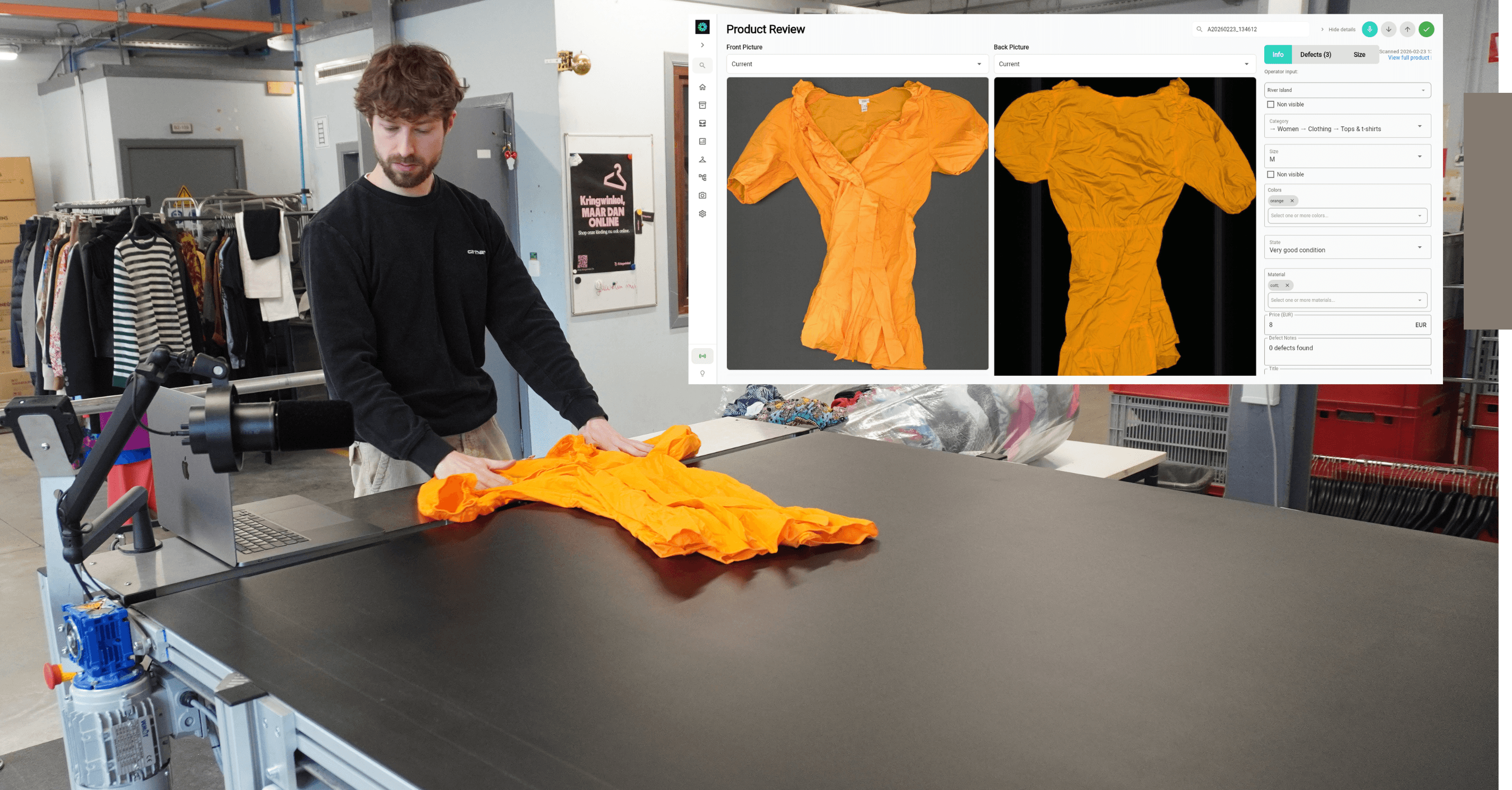
A record-keeping protocol. Article 22d(7) requires a description of the items in each bale, reflecting the most detailed sorting granularity they've undergone. This includes characteristics like type of clothes, size, colour, gender and material composition, along with anything else that contributes to efficient re-use.
A signed declaration that the shipment is fit for re-use and that none of the material is waste.
This last one is a claim about every garment in every bale, not about the bale average, and under the new regime the burden of proving it sits with you rather than with the inspector.
This is the real change. You already sort by grade. From 2027 that grade stops being a commercial description and becomes something you certify. And the proof has to travel with the clothes.
Whatever your line records is the only evidence you will have.
Note that "Fit for re-use" is not an absolute property of a garment. It is judged against the market the bale is destined for. A wool coat is re-usable in Poland and unsellable in Ghana.
Let's just export it as waste
This was my first reaction when I read the text. It doesn't work, for four reasons.
Several destinations close. From 21 May 2027, waste can only go to non-OECD countries on an EU approved list, due 21 November 2026. Twenty-four countries applied, among them Egypt, India, Pakistan and Nigeria. Ghana, Kenya, Tanzania, Mozambique and the UAE did not.
The receiving plant has to be audited. From 21 May 2027, every facility outside the EU, OECD or not, needs an accredited independent audit, renewed every two years. Commission it, buy access to someone else's, or use the facility's own. Either way you hold the report, or the shipment can be treated as illegal.
You still have to sort. The sorting obligation applies before any shipment, to used and waste textiles alike. Shipping unsorted material is not available under either classification.
The paperwork gets heavier. Waste needs an Annex VII document completed before departure and a contract with a take-back clause. Mixed loads that don't qualify as clean green-list material fall into full notification and consent from every authority on the route, plus a financial guarantee.
To whom are you allowed to sell which products in 2027?
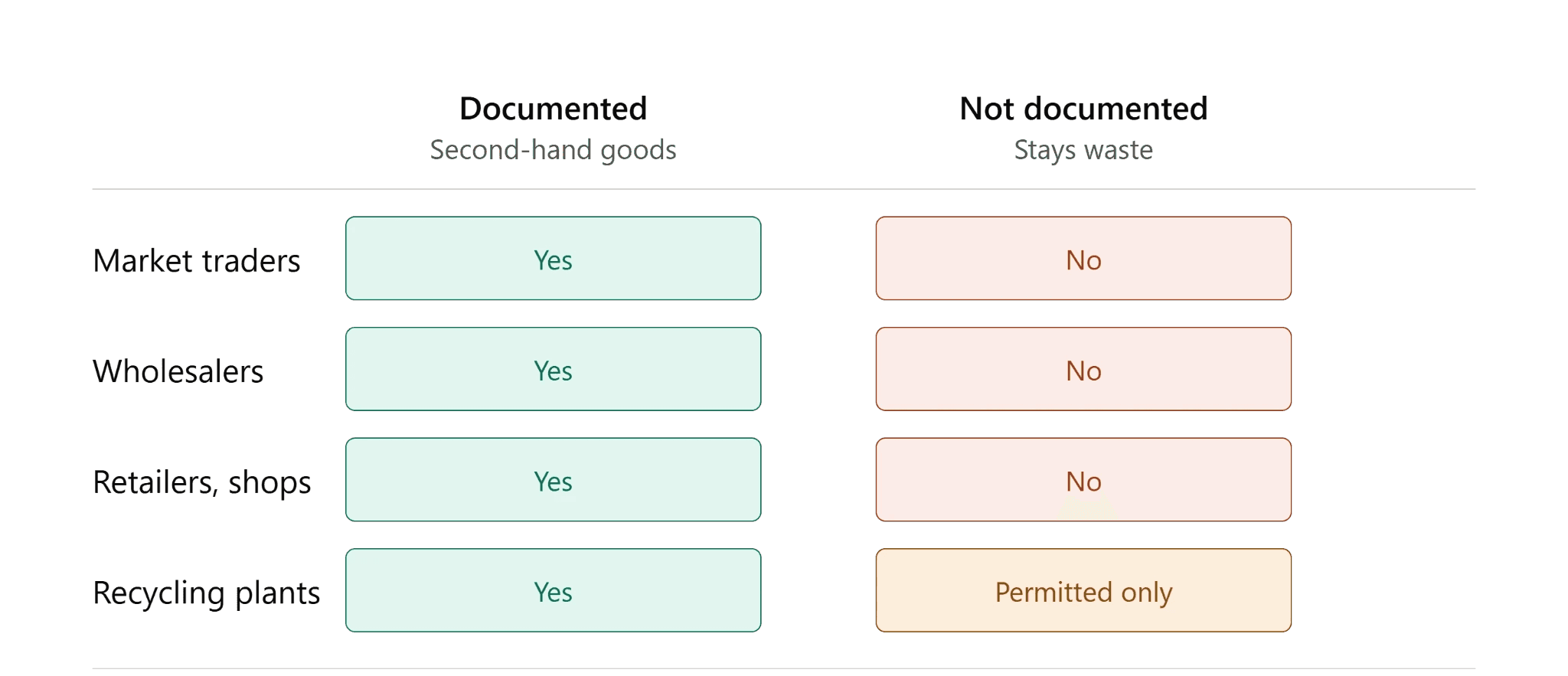
Set aside the paperwork. That is the question the new rules actually put to you.
The table covers EU-side classification only; a documented shipment still has to satisfy the importing country's own rules on used-clothing imports.
Waste may only be shipped to a recovery facility holding a permit or registration under the Waste Framework Directive, and that facility must present its permit before the shipment takes place.
That rules out the buyer your business actually depends on. You cannot ship waste to a market trader in Accra. You cannot ship it to a clothing wholesaler in Dubai. It goes to a permitted recycling plant, and a recycler pays recycling prices, not wearable-garment prices.
So the choice is not "sort, or ship as waste instead." It is:
Either you sort and document it, or you leave the re-use market and become a supplier of recycling feedstock.
What that means for a sorting line
The question is no longer whether you sort. It is whether you can defend the grade you put on the bale. For an operation recording at item level, that means capturing:
clothing type, size, colour, gender, material composition
the re-use decision: direct re-use, preparation for re-use, remanufacturing or recycling
the condition assessment and the defects behind it
which bale it went into, and when
who or what performed the assessment, and under which version of your sorting criteria
Those item records, grouped per bale and paired with the name and address of the facility, constitute your compliance pack.
What is still open
Three things are not settled, and all three could shift the detail:
The sorting requirements themselves. The Directive leaves the detailed granularity standard to be developed by the Commission as a priority, as part of the harmonised end-of-waste criteria, including rules on initial sorting at the collection point.
End-of-waste criteria for textiles. The Commission has said it will propose an implementing act, based on Joint Research Centre work, defining when sorted textiles cease to be waste. This sets the technical bar for "fit for re-use."
The non-OECD country list, due 21 November 2026. Applying is not approval, and the list authorises specific waste streams rather than waste in general.
National transposition will also vary. Belgian, German, Dutch and French implementations are unlikely to be identical, and Member States may go beyond the minimum.
Sources
Legislation
Directive 2008/98/EC (Waste Framework Directive), consolidated text in force from 16 October 2025. Article 22d, in particular Article 22d(7) on documentation accompanying shipments. https://eur-lex.europa.eu/eli/dir/2008/98/2025-10-16/eng
Directive (EU) 2025/1892 amending Directive 2008/98/EC on waste. New Articles 22a to 22d, and recitals 23, 48, 49 and 50. https://eur-lex.europa.eu/eli/dir/2025/1892/oj
Regulation (EU) 2024/1157 on shipments of waste. https://eur-lex.europa.eu/eli/reg/2024/1157/oj
Commission material
Waste shipments: procedures and export rules. https://environment.ec.europa.eu/topics/waste-and-recycling/waste-shipments_en
Implementation of the Waste Shipment Regulation, including the country-listing procedure. https://environment.ec.europa.eu/topics/waste-and-recycling/waste-shipments/implementation-waste-shipment-regulation_en
First non-OECD countries request eligibility to import non-hazardous EU waste. https://environment.ec.europa.eu/news/first-non-oecd-countries-request-eligibility-import-non-hazardous-eu-waste-2025-02-24_en
Analysis
Beveridge & Diamond, EU Targets Textile Waste with Waste Framework Directive Amendments. https://www.bdlaw.com/publications/eu-targets-textile-waste-with-waste-framework-directive-amendments/
DLA Piper, New EU Waste Shipment Regulation: stricter controls and increased compliance obligations. https://www.dlapiper.com/en-us/insights/blogs/environment-health-safety-and-product-compliance/2026/new-eu-waste-shipment-regulation-stricter-controls
EuroCommerce, Waste Shipment Regulation: harmonising classification of waste. https://www.eurocommerce.eu/2025/10/waste-shipment-regulation-harmonizing-classification-of-waste-to-accelerate-the-circular-economy/
ECOS & EEB, position on end-of-waste criteria for re-use textiles. https://eeb.org/wp-content/uploads/2025/05/ECOS-and-EEB-position-on-End-of-Waste-criteria-for-reuse-textiles-final.pdf
This article summarises EU legislation for general information. It is not legal advice; national transposition will vary and operators should confirm requirements with their competent authority or counsel.