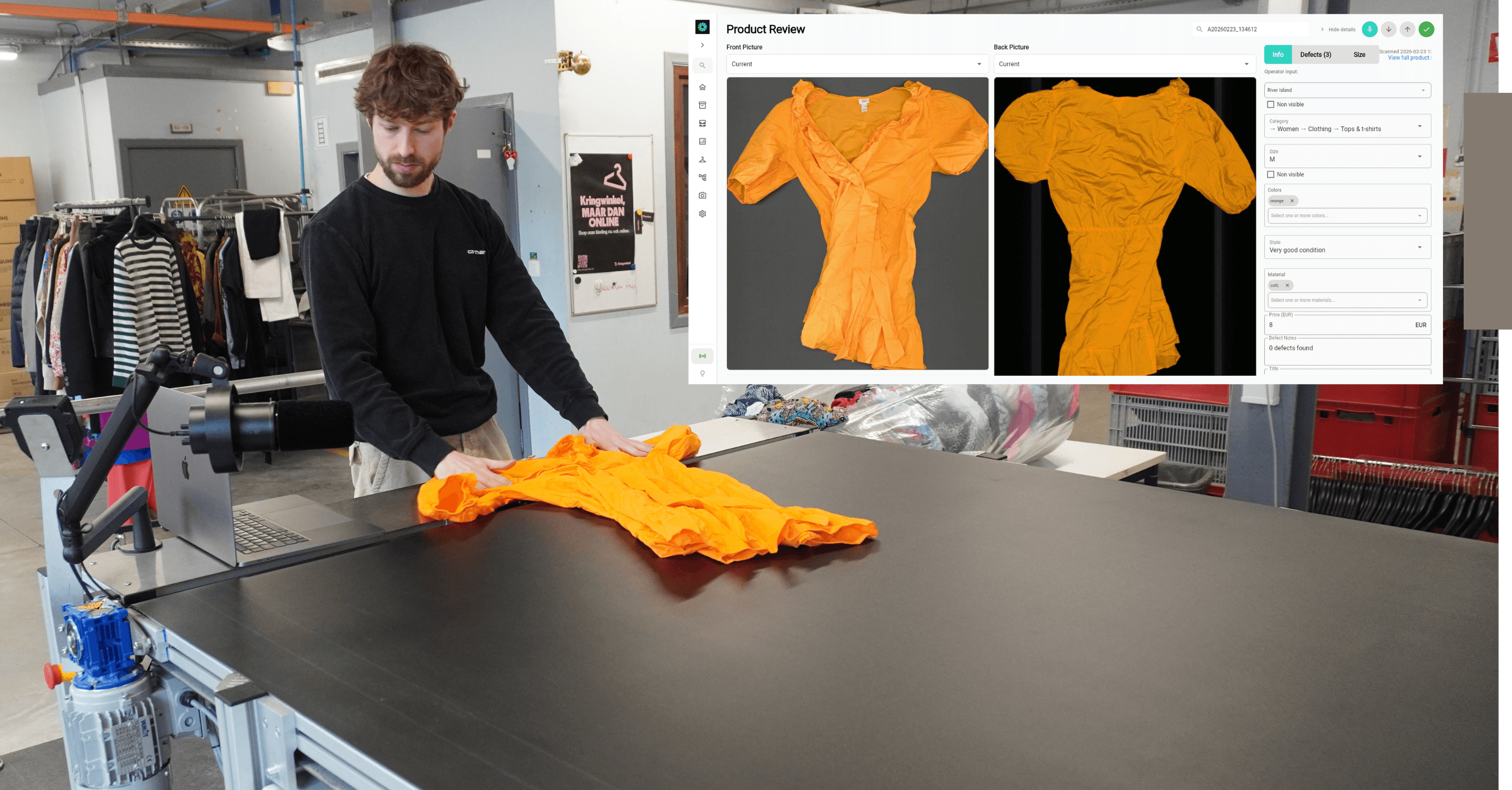

In short: A textile sorting centre on the other side of the world uses SortMate to grade, price and label every garment in a single pass. Since SortMate was installed, its shop network has kept growing, and it plans to keep expanding. It is now working towards a complete sort with dozens of categories, while keeping its warehouse team lean.
SortMate is Trosort’s AI sorting line. An operator lays a garment flat on a belt. Cameras scan the front and back, and the AI reads the brand, type, condition and defects. A pricing engine adds a price, and a label prints right after the scan. Compressed-air ejectors then send the garment into the right bin, headed for the right shop.
The centre collects more than 10,000 tonnes of textiles a year and sorts part of it for its own shops. It used to export the rest. With export prices falling and new legislation coming, it wants to sort and sell most of that volume locally, to one consistent standard.
Here is what that changed in practice:
Every garment arrives priced and labelled, ready for the shop floor.
A learning loop: every sale feeds back into pricing through the POS.
Growth without hiring in proportion: more shops, without a team that grows with each one.
One standard: the same rules, applied the same way every time.
From a Handful of Grades to a Full Sort
Today, the centre’s team pre-sorts by quality by hand before items reach the machine. SortMate then sorts them into a handful of pricing grades, from basic to designer.
Each grade sends garments to the right shop at the right price. SortMate decides from what it captures at the scan: the garment’s attributes (sleeves, neckline, closure, pockets, fit, length, print and construction), its condition, and how premium the item and its brand are.
The next step is much bigger. The centre wants to move to dozens of categories, so SortMate runs the complete sort, including the quality pre-sort that is still done by hand. SortMate supports 450+ customer-defined categories, so there is room to grow.
A Pricing Engine Built for Their Shops
Every garment leaves SortMate already priced and labelled.
We built a pricing engine specifically for this client. It starts from their existing sales data. A dynamic pricing algorithm looks at what the item cost when new, then applies discounts based on the brand and quality of the garment.
Right after the scan, our labelling system prints a barcode on each item. The garment goes straight to the right shop category with its price on it.

Closing the Loop With the POS
Every sale teaches the system something about the garment that was sold.
SortMate is integrated with the centre’s sales system. The barcode we print is the one scanned at checkout, so each sale links back to the exact scan: the garment’s attributes, its condition and the price we estimated.

From there, the centre can see:
how long the item took to sell, from scan to sale
in which shop it sold
what discount it needed
which customer groups buy what

All of this feeds back into pricing, so prices can be tuned for each shop and each customer group based on what actually sells.

More Shops, Roughly the Same Team
Opening more shops would normally mean hiring in proportion. The centre plans to keep expanding while keeping its warehouse team lean: a few extra hands, not a team that grows with every new shop. SortMate sorts for resale at up to 1,200 garments an hour with two operators.
There is a second gain: consistency. Pricing, grading and choosing the destination shop used to happen in each employee’s head, and everyone did it a little differently. Management wanted one standard, applied to every garment. SortMate applies that standard every time, so the sort is objective and based on data, not individual judgement.
Making It Work From the Other Side of the World
A machine running on the other side of the world while our team sits in Belgium only works if support is part of the product. That is where we put the emphasis on this project.

It takes clear documentation, responsive remote support and close follow-up with the team on site as they move towards a complete sort.
The result is a system in production that runs without issues, and a team that keeps raising its ambitions.
Conclusion: What the Centre Gained With Trosort
By grading, pricing and labelling in one pass, the centre turned a manual, subjective step into a fast, consistent one. In concrete terms:
A shop network that keeps growing
A handful of pricing grades today, a complete sort with dozens of categories next
Garments that reach the shop already priced and labelled
Prices tuned to each shop and customer group, using real sales data
One sorting standard, applied the same way by every operator
Growth without hiring in proportion
Remote support that bridges the distance
A system in production that runs without issues
Does your sorting centre face the same pressure on export prices and labour? Book a call and we’ll look at your sorting chain together, or plan a visit to see SortMate running.
FAQ
What is SortMate, the machine used in this case?
SortMate is an AI sorting line built by Trosort. It scans each garment, reads its brand, condition and defects, suggests a price and routes it to the right shop category. Operators feed it, so it is semi-automatic.
Can a sorting centre grade and price garments in the same step?
Yes. SortMate grades, prices and labels each garment in a single pass, using the customer’s own rules and sales data.
How does a pricing engine set prices for second-hand clothes?
It starts from the shop’s own sales data and looks at what the item cost when new. It then applies discounts based on the brand and quality of the garment. For this client, we built the engine specifically around their shops.
Does SortMate connect to a POS system?
Yes. In this case the printed barcode is scanned at the shop checkout, so each sale links back to the original scan. SortMate also integrates with ERP and WMS systems.
How can a sorting centre open more shops without hiring more sorters?
By letting the machine make the grading, pricing and shop-allocation decisions that used to be made by hand. In this case, the centre keeps expanding its shop network while keeping its warehouse team lean: a few extra hands, not a team that grows with every new shop.